

If you've ever googled "what is classical music", you've already been handed the answer: "a broad tradition of Western art and concert music, running from the 11th century to the present day".
You probably half-knew that already. A definition isn't really why you're here.
The questions you actually came with are messier.
Does any old music count as classical?
It it all orchestras and violins?
If someone writes for the violin today, is that classical too?
What about the calm piano music that streaming apps file under "classical" — is that the real thing?
Does music this formal even fit an ordinary Tuesday — on the bus or doing the dishes?
And maybe even this one:
Is it ok not to enjoy it?
That's what the Virtuoso blog is here for: helping you understand classical music and answer the questions you actually have. And to start it, we need a short look back.
It begins a long time ago, over a thousand years back, with the church as institution — rich enough, powerful enough, and interested enough to want its music written down. Sound was how you made people feel something vast, how you filled enormous stone buildings with the sense that God was somewhere in the room. Monks worked out how to put music on a page, so it could be sung again, the same way, anywhere. For a long time the church was the main reason music got written at all.
Then printing changed everything, around 1500. Music could be copied and carried from one city to the next — far cheaper, and no longer the church's alone. It moved into palaces and grand homes, where nobody wanted hymns at dinner, so new music grew for new rooms: for courts, for dancing, for the pleasure of an evening. From there it spread quickly.
Eventually it took a stage of its own. Halls and opera houses went up, and anyone with a ticket could come. Composers became famous and performers became stars — Mozart and Beethoven were the celebrities of their day. This was the popular entertainment of its time. The grand halls, the orchestras, the hush and the dressing-up we picture now — that's the furniture this music grew up with, from the years when it was the main event in town.
So for about four centuries, from 1500 to 1900, the music developed across Europe — and that span is what we mean by Western classical music. A lot happened inside it: the sound changed completely from one century to the next, and each generation of composers built on what the last one had worked out. Then came recordings, radio, and jazz, pop, rock and everything else that arrived in the century after.
If you feel like you don't know much about any of this, that's what Virtuoso is for. There's a free course in it called The Brief History of Classical Music — about an hour, no subscription needed. It takes you through five hundred years: the eras, how the sound changed from one to the next, the composers who mattered and the pieces worth knowing, all of which you hear as you go. By the end you'll have a rough map of the whole thing, and enough of a sense of it to know where you want to go next.
You've probably already noticed some confusion over what counts as "classical music." The era that officially owns the name is tiny: barely seventy years, around the year 1800 — the Classical era proper, with a capital C. Haydn, Mozart, Beethoven. Music admired for being clear, balanced, unfussy. In a textbook, that, and nothing else, is "Classical." A neat and narrow window.
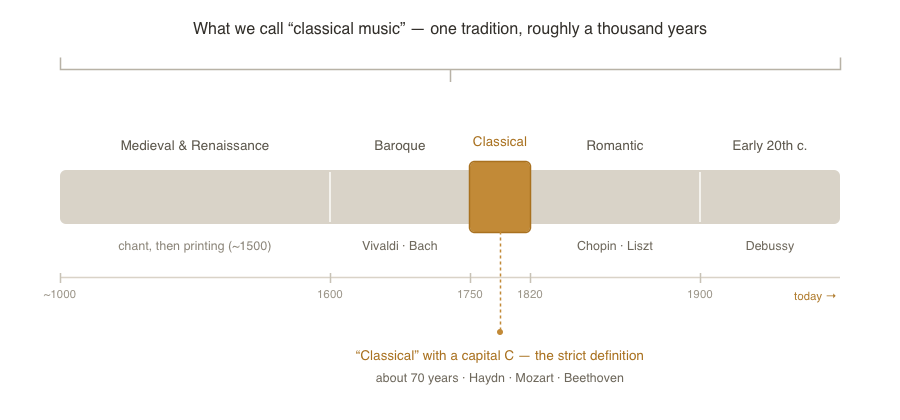
But in real life we call all four centuries classical — and then some. Before that narrow window came the Baroque, with Vivaldi and Bach. After it came the Romantics, Chopin and Liszt. Even Debussy, drifting in at the start of the twentieth century with music that sounds nothing like Mozart, counts. None of them sit inside the strict little era, yet all of them are classical to us — not by date, but by belonging to the same long line. And when a piece reaches you and you find yourself wondering is this classical?, you aren't really asking when it was written. You're asking whether it belongs to that tradition.
Simply this: for almost a thousand years, one generation of composers drew on the last and added something new. One worked out how to write music down. The next built harmony on top. Others shaped it into symphonies and sonatas. Each step kept what came before and pushed it further — from Vivaldi's generation to Haydn, Mozart to Beethoven, Beethoven to Wagner. Music belongs to this tradition when it grows out of that chain — when it uses what all those centuries figured out. A new film score can belong to it. A folk song passed around by ear never did.
And that's the point of calling it a tradition: there are others. Jazz is its own line, grown from blues and spirituals and rhythms carried over from Africa. Rock came up through jazz, blues and country. Pop and electronic music built their own chain again, out of studios and machines. They're just different families, with different roots. Classical is the oldest of them, and the one that wrote everything down. So when you ask whether a piece is classical, you're really asking which family it comes from.
So, back to where we started. Does old music automatically count classical music? No — age was never the point. A folk tune from five centuries ago stayed outside the tradition; a film score written this year can belong to it. Is it all orchestras and violins? No — the orchestra is just the loudest version. The same tradition runs through a single piano, or one unaccompanied voice. And if someone writes for the violin today, is that classical? It can be — nobody ever closed the tradition off. All three turn on the same thing: not how old the music is, not what's playing it, but where it comes from.
Only the last question is harder. That calm piano on your "classical" playlist — is it the real thing? Not quite. It borrows the instrument and the mood, but it was made for the playlist, not handed down the line. Close, but just outside.
Underneath a lot of these questions, though, sits a different one — not "what counts as classical?" but "is any of this really for me?" And that usually starts with how formal it all looks. Does music this formal even fit an ordinary Tuesday, on the bus or doing the dishes? It does. The formality was never in the music — it's in the room: the hush, the still audience, the dressing-up, all left over from the years when this was the main entertainment in town. A Bach piece doesn't know whether you're in a velvet seat or on a crowded bus with one earbud in. Play it where you like.
So is it ok not to enjoy it? Completely. A lot of it will leave you cold, and liking it was never the point. (We set out why in Why should you know about classical music?)
Knowing a bit about it is another matter. It's one of the oldest stories in Western culture, and it's worth being able to place — the way you'd recognise a famous painting without wanting it on your wall. That's what Virtuoso as a classical music guide is for: a thousand years of music in plain language, a few minutes at a time, with the music playing as you go.
And if you'd rather just try listening first, we have a separate guide on [how to start listening to classical music] — where to begin, what to put on, and how to fit it into a normal week.